A research team led by Zhao Qi, associate professor in the Faculty of Health Sciences (FHS) at the University of Macau (UM), has made significant progress in targeted cancer immunotherapy. The team has developed a novel type of antibody-engineered lipid nanoparticles (LNPs). These smart nanoparticles can deliver chemotherapy drugs precisely to the tumour site, while also reprogramming tumour cell metabolism to reverse the immunosuppressive tumour microenvironment and activate the body’s immune system to kill tumour cells. The research has been published in the international journal Advanced Science.
Triple-negative breast cancer (TNBC) is widely regarded as the most malignant subtype of breast cancer. Currently, chemotherapy remains the cornerstone of its treatment. However, conventional chemotherapeutic agents lack specificity, often causing severe toxic side effects in normal tissues while killing tumour cells. Furthermore, monotherapy with chemotherapy cannot completely eradicate tumour cells, and often leads to tumour recurrence and metastasis. In recent years, combining chemotherapy with immunotherapy has emerged as a promising new approach. This approach aims to kill tumour cells with drugs while activating the patient’s own immune system (especially T lymphocytes) to identify and eliminate residual cancer cells. However, tumour cells create an immunosuppressive tumour microenvironment (TME) by overexpressing immune checkpoint proteins such as PD-L1 and secreting immunosuppressive factors such as TGF-β1. This depletes T cell function and leads to a poor immune response.
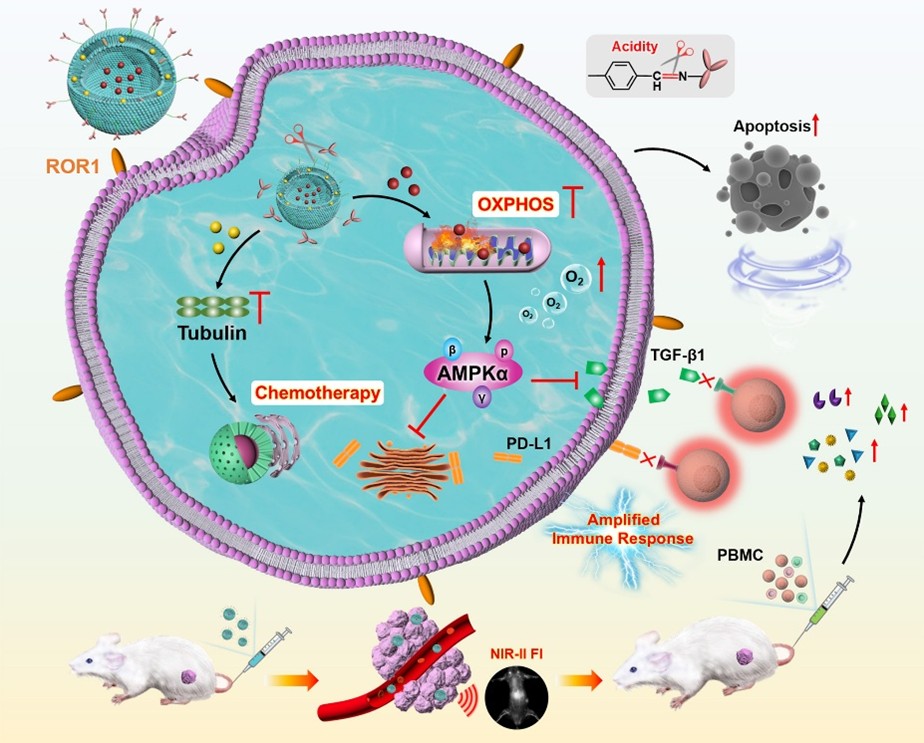
To address the challenges associated with targeted drug delivery and immunosuppression, the research team designed and fabricated a multifunctional LNP called Lip(MA+Met)-R1. It has two advantages:
(1) Precise navigation and visualisation: The LNP surface is conjugated to a human receptor tyrosine kinase-like orphan receptor 1 antibody (ROR1 Ab) via an acid-labile linker. This enables the LNPs to target and accumulate in tumour tissues. Meanwhile, the lipid bilayer incorporates a second near-infrared (NIR-II, 1000-1700 nm) fluorescence probe, enabling high-resolution, real-time fluorescence imaging of deep-seated tumours, and providing direction for precision treatment.
(2) Dual payload and synergistic treatment: The LNPs encapsulate two types of ‘ammunition’, a chemotherapeutic drug and an immunoadjuvant. The chemotherapeutic drug is monomethyl auristatin E (MA), a cytotoxic agent which inhibits microtubule function in tumour cells, leading to cell division arrest and apoptosis. The immunomodulatory drug is metformin (Met), a commonly used clinical drug which activates AMPK protein phosphorylation by inhibiting mitochondrial oxidative phosphorylation (OXPHOS) in tumour cells. This process results in abnormal glycosylation and degradation of the PD-L1 protein, thereby downregulating PD-L1 expression in the cell membrane and cytoplasm and reducing the secretion of TGF-β1. This fundamentally reverses the immunosuppressive TME and enhances the immune response.
The first author of this study is Dai Yeneng, research assistant professor in FHS. The corresponding authors are Prof Zhao and Zhu Lipeng, lecturer in the School of Life Sciences at Central South University. The project was funded by the Science and Technology Development Fund of the Macao SAR (Grant Nos.: 0150/2025/AFJ, 0009/2023/RIC, and 0065/2025/ITP1), the University of Macau (Grant Nos.: MYRG2022-00143-FHS and MYRG-GRG2023-00158-FHS-UMDF), and the Natural Science Foundation of Guangdong Province (Grant No.: 2023A1515010549). The full article is available at: https://doi.org/10.1002/advs.202518468
| Source: Faculty of Health Sciences | |
| Media Contact Information: | |
| Communications Office, University of Macau | |
| Albee Lei | Tel: (853) 8822 8004 |
| Bell Leong | Tel: (853) 8822 8009 |
| Email: | prs.media@um.edu.mo |