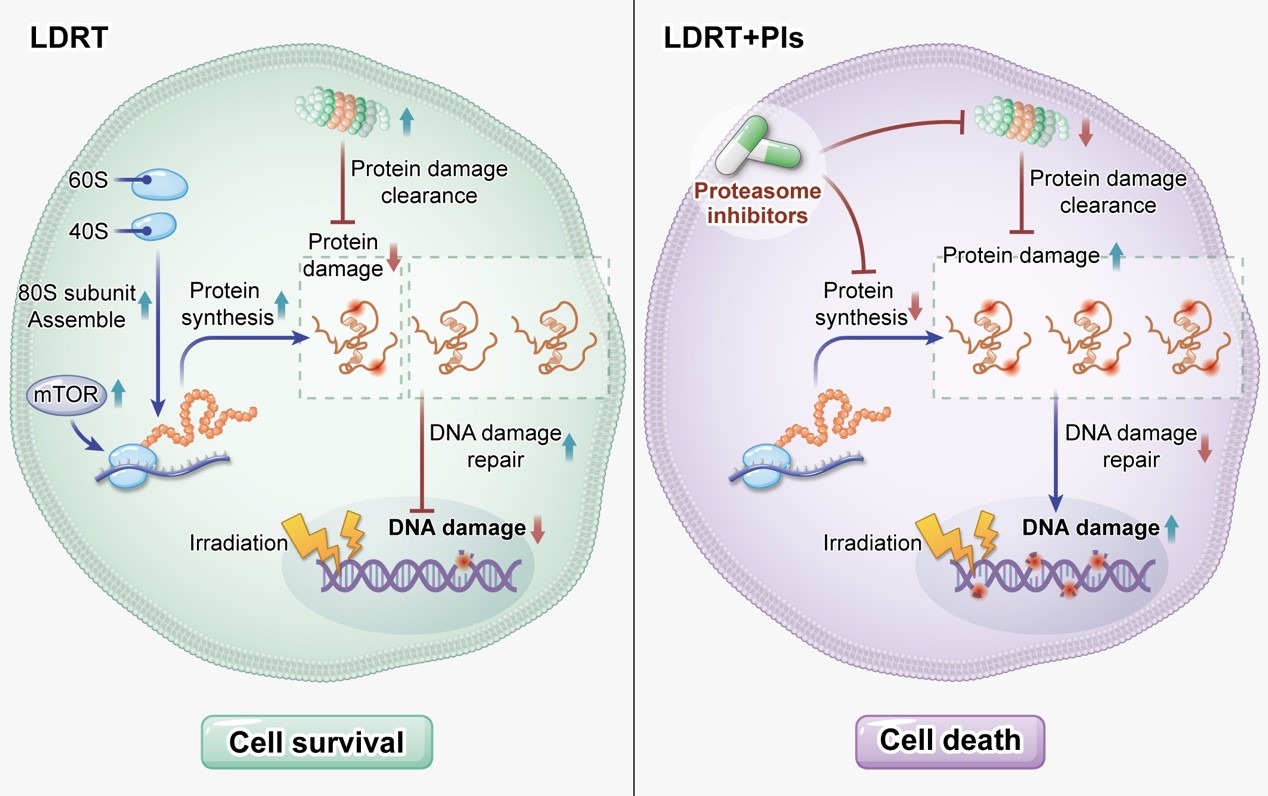
A research team led by Chuxia Deng, chair professor in the Faculty of Health Sciences (FHS) at the University of Macau (UM), has made a significant breakthrough in understanding resistance to radiotherapy. The study, for the first time, revealed distinct mechanisms underlying tumour-cell responses induced by low-dose versus high-dose radiotherapy. The team found that low-dose radiotherapy can significantly promote de novo protein synthesis and induce protein damage. Moreover, when combined with proteasome inhibitors, protein-damage clearance can be effectively blocked, thereby enhancing anti-tumour efficacy while reducing toxicity to normal tissues. The research findings have been published in the international journal Drug Resistance Updates.
Radiotherapy is a cornerstone of the treatment for solid tumours, with around half of all cancer patients receiving it. However, some patients are intrinsically resistant to radiotherapy, while others develop acquired resistance after treatment. To reduce the toxic side effects of high-dose radiotherapy on normal tissues, clinical practice often uses fractionated low-dose radiotherapy. However, prolonging the treatment period may promote resistance. Traditionally, resistance to radiotherapy has primarily been attributed to DNA damage repair mechanisms, while the role of protein damage has long been overlooked.
By systematically comparing the effects of low- and high-dose radiotherapy on tumour cells, the research team discovered that the cellular responses differed markedly. High-dose radiotherapy triggers strong responses to DNA damage, activates cell-cycle checkpoints, causes cell-cycle arrest, suppresses proliferation, and inhibits de novo protein synthesis. In contrast, low-dose radiotherapy causes weaker DNA damage. While cell-cycle progression is largely maintained, de novo protein synthesis is significantly promoted, including a large number of DNA repair-related proteins.
Further studies have revealed that protein damage induced by radiotherapy mainly affects newly synthesised proteins, and that the severity of this damage is closely correlated with the rate of protein synthesis. Blocking protein synthesis can completely prevent this type of damage, whereas promoting prematurely terminated nascent peptide chains can exacerbate it. In dividing cells, where protein synthesis is more active, radiotherapy-induced protein damage is even more pronounced.
Since low-dose radiotherapy significantly promotes de novo protein synthesis, resulting in efficient protein damage comparable to that caused by high-dose radiotherapy, the research team proposed targeting protein damage clearance as a novel combination therapy. Experiments showed that combining low-dose radiotherapy with proteasome inhibitors prevents the clearance of damaged proteins, leading to their substantial accumulation. At the same time, this combination significantly suppresses de novo protein synthesis, thereby preventing the production of key DNA repair proteins, weakening DNA repair capacity, and markedly increasing tumour-cell death.
In animal models, low-dose radiotherapy combined with proteasome inhibitors was as effective as high-dose radiotherapy combined with the same strategy, but with significantly less toxicity to normal tissues. In the high-dose group, clear skin toxicity was observed; in contrast, the low-dose combination group showed no significant adverse effects. The combined strategy also demonstrated superior anti-tumour effects compared with radiotherapy alone in three-dimensional tumour tissue slices and patient-derived organoid models.
Notably, this protein damage response mechanism is similar to the team’s earlier research on chemotherapy resistance. Multiple chemotherapeutic drugs preferentially bind to newly synthesised proteins, causing misfolding and oxidative damage. Cancer cells then survive through a ‘protein damage response’, which includes ubiquitination-mediated tagging and proteasome clearance. The study further confirmed that proteasome inhibitors available for clinical use can effectively reverse this form of resistance. This research was published in the international journal Cell Discovery.
Overall, this study is the first to systematically elucidate differences in cellular responses to radiotherapy at different doses and proposes a new strategy that combines low-dose radiotherapy with proteasome inhibitors. This approach maintains anti-tumour efficacy while substantially reducing toxicity, offering valuable insights for optimising radiotherapy in clinical settings.
The corresponding authors of this study are Prof Deng and Adjunct Associate Professor Xu Xiaoling in FHS. The first authors are Research Assistant Professor Shao Fangyuan, and PhD student Li Zongjie in FHS. Other FHS members also made substantial contributions to the study, including Professor Edwin Cheung Chong Wing, Associate Professor Tam Kin Yip, and PhD students Ran Maoxin, Chen Yujun, Liu Junlin, Li Bo, Hong Mengyu, Si Qi, Ye Xiangyang, Chu Xiangpeng, and Hou Yuxing. The research was funded by the Natural Science Foundation of China (Grant Nos.: 82573786, 82030094 and 82303921), the National Key R&D Program (Grant No.: 2021YFE0206300), the Science and Technology Development Fund of the Macao SAR (Grant Nos.: 0009/2022/AKP, 0138/2022/A, 0071/2023/RIA2, 0054/2023/RIA1, 0129/2024/RIA2, 0059/2024/ITP2, 0064/2025/ITP1), and the University of Macau (Grant Nos.: CPG2024-00020-FHS, CPG2025-00035-FHS, MYRG2023-00029-FHS). The full version of the research article can be accessed at: https://pubmed.ncbi.nlm.nih.gov/41844504/
| Source: Faculty of Health Sciences | |
| Media Contact Information: | |
| Communications Office, University of Macau | |
| Albee Lei | Tel: (853) 8822 8004 |
| Bell Leong | Tel: (853) 8822 8009 |
| Email: | prs.media@um.edu.mo |