A research team led by Associate Professor Liu Tzu-Ming in the Faculty of Health Sciences (FHS) at the University of Macau (UM), in collaboration with Professor Yehuda G. Assaraf at the Technion – Israel Institute of Technology and Chief Physician Zeng Ning at Zhujiang Hospital of Southern Medical University, has, for the first time, identified and systematically elucidated an endogenous red autofluorescence signal originating from DNA aggregation. The study confirms that this signal can serve as a universal, label-free biomarker for cell death, senescence (ageing), and sepsis. This discovery holds significance in two aspects: firstly, it identifies a new molecular marker that can help identify cellular problems and diseases with greater precision; secondly, it shows that a massive accumulation of DNA within lysosomes is a distinctive phenotype of cellular ageing and death. The research has been published in the biomedical journal Theranostics.
Cell death and senescence are core biological processes essential for maintaining homeostasis and development, as well as for responding to external stimuli. Real-time, in situ dynamic monitoring of these processes is crucial for both basic research and clinical diagnosis. However, current fluorescence-based monitoring methods typically rely on exogenous probes, which are often invasive, cytotoxic, and unsuitable for in vivo and 3D organoid models.
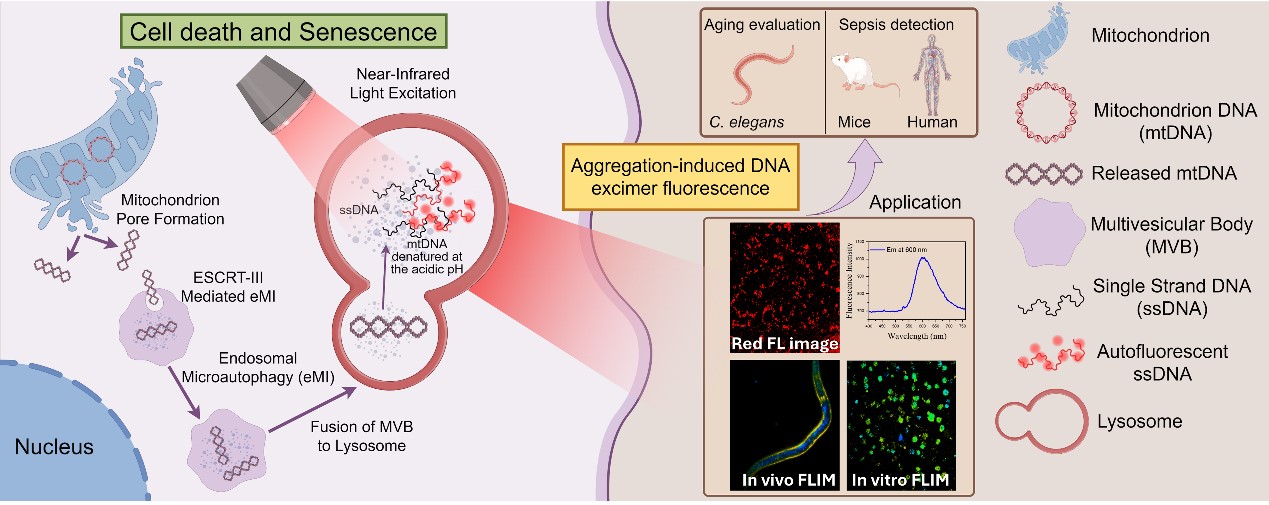
The team initially discovered an unexpected red autofluorescence (peaking at approximately 600 nm) in apoptotic cells that could be excited using 1060 nm two-photon excitation. To determine its origin and mechanism, the team conducted a series of experiments involving lysosome isolation, high-throughput sequencing, and photophysical analysis. The results confirmed that the signal primarily originates from mitochondrial DNA (mtDNA) that has entered the lysosomes.
The team also discovered that, under stress, mtDNA released into the cytoplasm is transported to lysosomes via the ESCRT (endosomal sorting complex required for transport)-mediated microautophagy pathway. In the acidic environment of the lysosome, the DNA double helix unwinds into single strands and undergoes molecular aggregation. This triggers the aggregation-induced emission (AIE) effect, inducing cell death.
The research team further validated the universality of this signal across various modes of cell death, including apoptosis, ferroptosis, necroptosis, and pyroptosis, as well as during cellular senescence. More importantly, the team applied this technology to in vivo models. They achieved non-invasive monitoring of the ageing process in C. elegans and detected enhanced fluorescence signals in mouse models of sepsis and in plasma samples from human patients with sepsis. These results highlight the immense potential of this fluorescence signal as a biomarker for disease diagnosis.
This research marks the first time that DNA aggregation within lysosomes has been directly linked to the fluorescence properties of AIE, providing a new label-free endogenous optical reporting system for the study of cell death and senescence. This breakthrough overcomes the limitations of traditional detection methods, providing a powerful visualisation tool for tracking cell fate in real time within complex systems, such as in vivo models and organoids. Future studies will focus on the application of this technology in research into ageing and nucleic acid metabolism disorders, as well as to monitor tumour drug resistance, with the potential to revolutionise research on disease mechanisms and the early diagnosis of these major diseases.
The corresponding authors of this study are Prof Liu, Prof Assaraf, Dr Zeng, Xu Changhuo, research assistant professor in UM FHS, and Zheng Weiming, postdoctoral fellow in UM FHS. The first author is Hu Yiling, PhD candidate in UM FHS. Key contributions were also made by Chair Professor Shen Hanming, Associate Professor Zhang Hongjie, and research assistant Wang Xiaoyan in UM FHS, the Animal Research Core, and Chen Xiuping, professor in the UM Institute of Chinese Medical Sciences. The research was supported by the Science and Technology Development Fund of the Macao SAR (File Nos.: 0002-2022-AKP, 0024/2021/APD, 0003/2023/RIC, 0013/2023/RIC, 0054/2024/RIB1, 0038/2024/ITP2, 0131/2024/RIB2), and the University of Macau (File Nos: MYRG-CRG2022-00009-FHS, MYRG-GRG2023-00053-FHS-UMDF). The full article is available at: https://www.thno.org/v16p1063.htm.
| Source: Faculty of Health Sciences | |
| Media Contact Information: | |
| Communications Office, University of Macau | |
| Albee Lei | Tel: (853) 8822 8004 |
| Bell Leong | Tel: (853) 8822 8009 |
| Email: | prs.media@um.edu.mo |