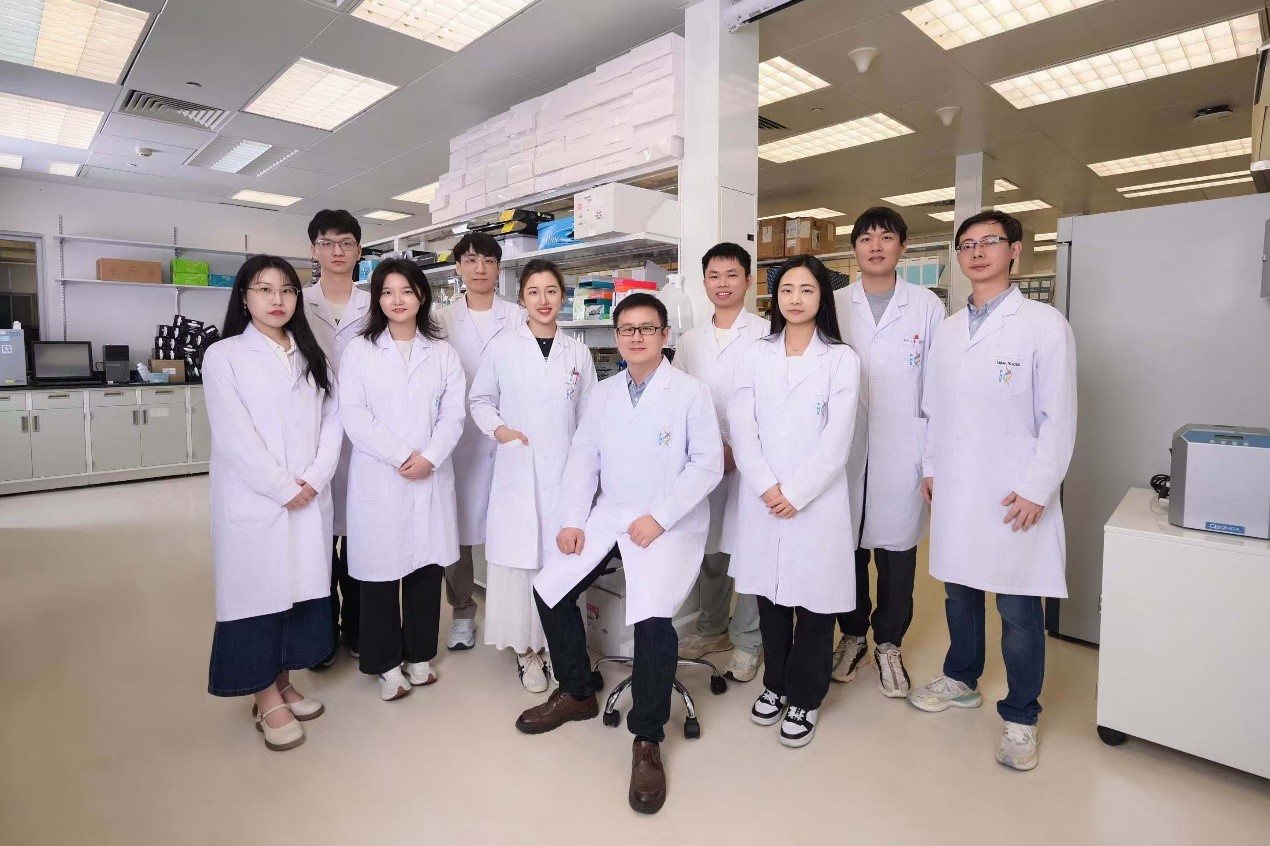
A research team led by Miao Kai, assistant professor in the Faculty of Health Sciences (FHS) at the University of Macau (UM), has made a significant breakthrough in understanding the metastasis of breast cancer to the lungs. Using innovative micro-organ chip technology, the team has, for the first time, revealed how tumour cells remotely ‘educate’ and reshape the lung microenvironment through secreted factors, forming a ‘pre-metastatic niche’ that favours cancer cell colonisation. The research precisely identified a core signalling axis, offering a novel potential therapeutic target for preventing the metastasis of breast cancer to the lungs. The findings have been published in the prestigious international journal Advanced Science.
Metastasis is the leading cause of cancer-related deaths. Before metastasis occurs, distant organs such as the lungs form a hospitable environment known as the ‘pre-metastatic niche’, preparing fertile ‘soil’ in advance for incoming cancer ‘seeds’. However, whether tumour cells can remotely orchestrate this complex process without direct contact, and if so, the underlying molecular mechanisms, remain elusive.
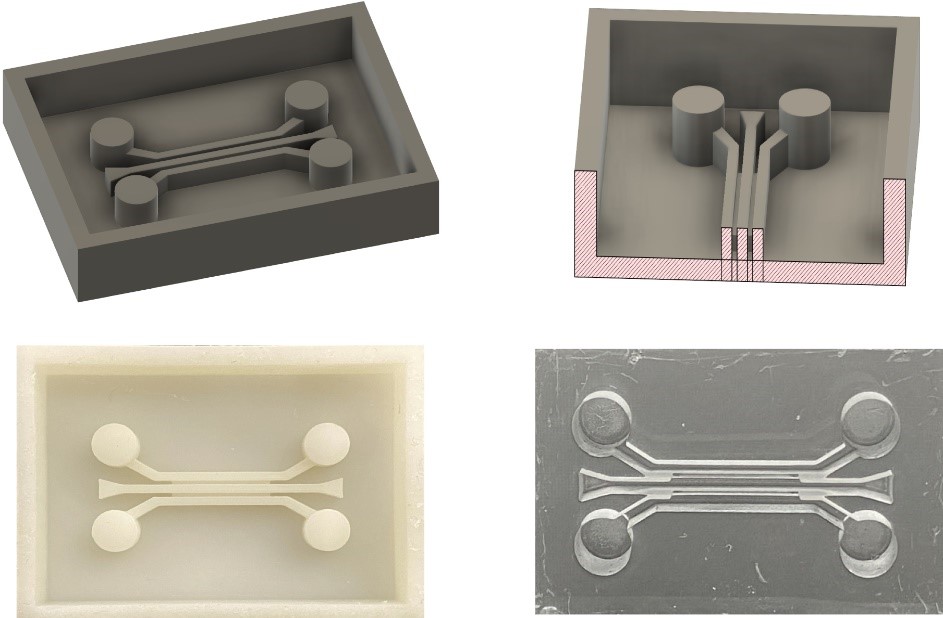
To address this issue, the UM research team successfully developed a three-dimensional tumour-lung micro-organ chip model. The chip features a permeable collagen barrier that enables long-term co-culture of tumour and lung tissues while keeping them physically separated, thereby accurately simulating the process of remote tumour-mediated lung microenvironment remodelling.
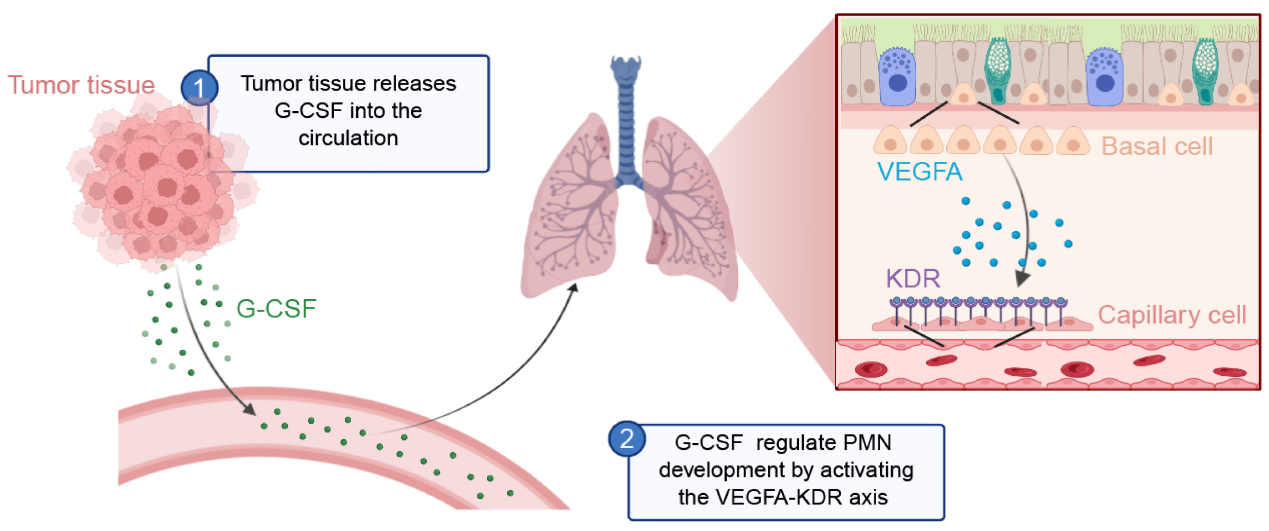
The team made several key discoveries: (1) Remote control: The study confirmed that tumour tissue, solely through secreted signalling molecules and without direct contact with the lung tissues, can successfully induce the formation of a fully functional pre-metastatic niche in the lungs, significantly enhancing the colonisation ability of circulating tumour cells. (2) Core signalling axis: Through integrated single-cell RNA sequencing and cytokine array analysis, the team identified granulocyte colony-stimulating factor (G-CSF) as a key tumour-derived mediator. It activates the VEGFA-KDR signalling axis in lung capillary cells. (3) Mechanism of action: Activation of the G-CSF→VEGFA→KDR axis drives angiogenesis and extracellular matrix remodelling in the lungs, creating a microenvironment conducive to the survival, growth, and metastasis of cancer cells. (4) Therapeutic potential: The study further demonstrated that pharmacological inhibition of KDR or antibody-based neutralisation of G‑CSF/VEGFA can effectively disrupt pre-metastatic niche formation and significantly suppress the metastasis of breast cancer to the lungs in animal models.
This research refines the understanding of how tumours remotely ‘prime’ distant organs, and more importantly, offers new clinical intervention strategies. While conventional treatments often focus on established metastatic lesions, the G-CSF-KDR axis proposed in this study provides a novel and precise therapeutic target for proactive prevention, disrupting the pre-metastatic niche before metastasis occurs. This ‘prevention is better than cure’ approach holds promise for fundamentally improving the prognosis of breast cancer patients.
The corresponding authors of this study are Prof Miao and Cao Yuhong, research fellow at the National Center for Nanoscience and Technology. The co-first authors are Zhang Jingxin and Huang Xiaoying, PhD students in FHS, and Ma Lingchuan, research assistant in FHS. Significant contributions were also made by Chen Zixing, undergraduate student in FHS; Wang Lijian and Guo Yutong, PhD candidates in FHS; Li Tianyao and Xu Hu, Cao Yuhong’s research team members at the National Center for Nanoscience and Technology; Li Junqi, professor in the Clinical Research and Translational Medicine Department at the Third Affiliated Hospital of Zhengzhou University; Qin Jiang-Jiang, deputy director of the Center for Innovative Drug Research at the Hangzhou Institute of Medicine, Chinese Academy of Sciences; and Wang Xiang, associate chief physician in the Department of Medical Oncology at Peking Union Medical College Hospital. The research was supported by the National Key Research and Development Program of China (File No.: 2021YFA1201100), the Science and Technology Development Fund of the Macao SAR (File Nos.: 0073/2021/A2, 0087/2024/RIB2, 0007/2021/AKP, 0009/2022/AKP, and 0004/2021/AKP), and the University of Macau (File Nos.: MYRG-GRG2023-00150-FHS-UMDF and MYRG-GRG2024-00146-FHS). The full article is available at: https://advanced.onlinelibrary.wiley.com/doi/10.1002/advs.202518584?af=R.
| Source: Faculty of Health Sciences | |
| Media Contact Information: | |
| Communications Office, University of Macau | |
| Albee Lei | Tel: (853) 8822 8004 |
| Bell Leong | Tel: (853) 8822 8009 |
| Email: | prs.media@um.edu.mo |