A research team led by Yuan Zhen, head of the Centre for Cognitive and Brain Sciences and professor in the Faculty of Health Sciences (FHS) at the University of Macau (UM), has developed an innovative wearable photoacoustic hemometabolic microscope (PHM). In addition to stroke research, the PHM system can be extended to studies of neurodegenerative disorders such as Alzheimer’s and Parkinson’s disease, offering significant implications for precision medicine and neuroscience. The findings have been published in the leading international journal Cell Reports Physical Science.
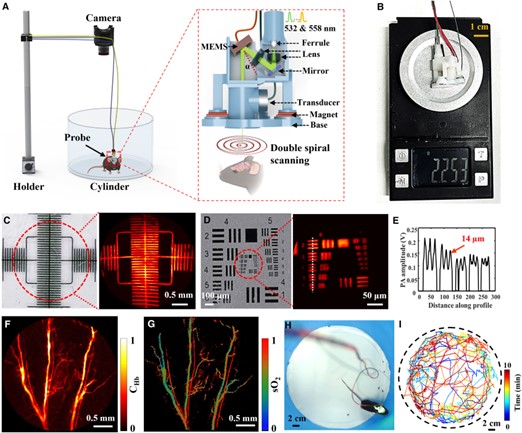
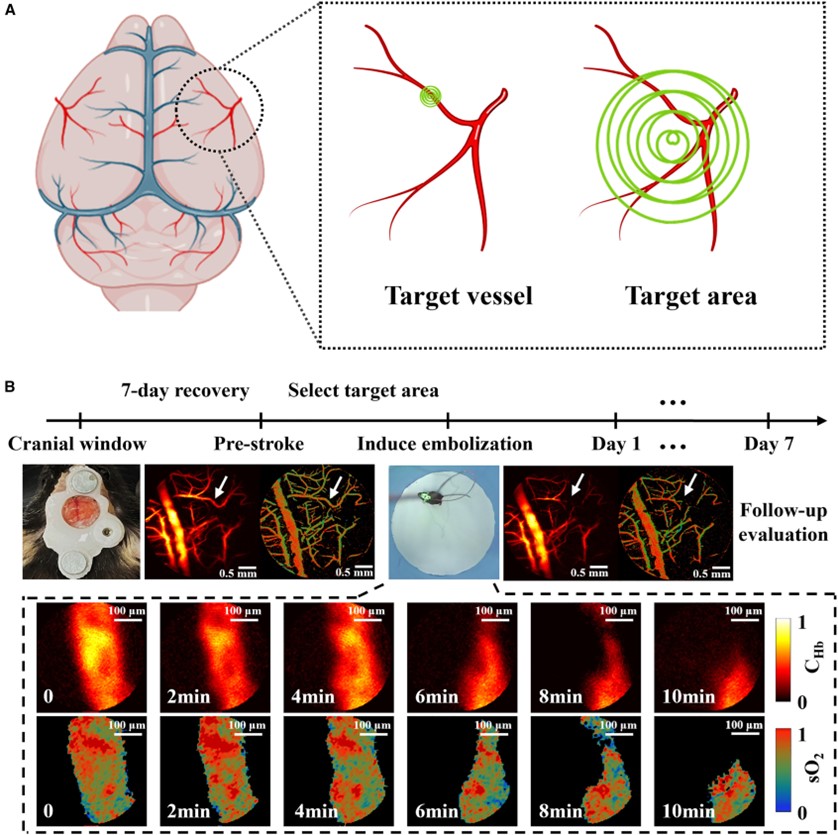
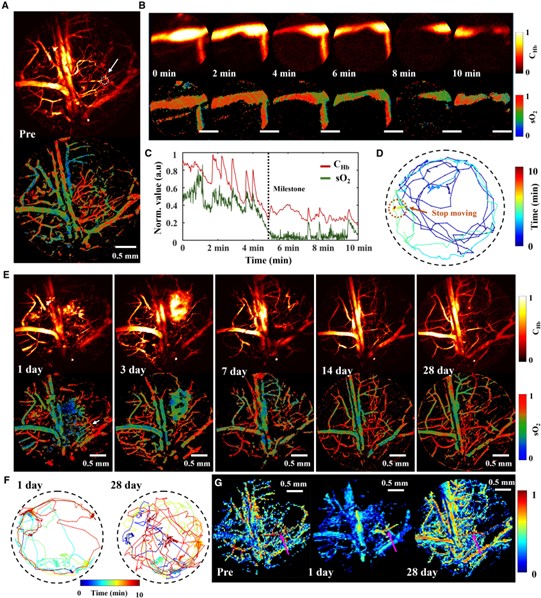
Stroke is a major cerebrovascular disease with severe consequences. Animal stroke models are essential for studying underlying mechanisms and therapeutic strategies. However, conventional approaches require anaesthesia or head fixation, which limits the ability to capture authentic physiological processes. The PHM overcomes these limitations by enabling precise induction of vascular occlusion in freely moving mice while simultaneously monitoring blood oxygen saturation and haemoglobin concentration in real time, thereby capturing thrombus formation and neurovascular-metabolic coupling dynamics.
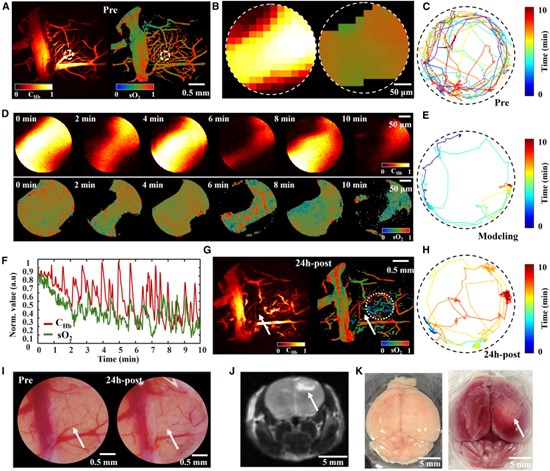
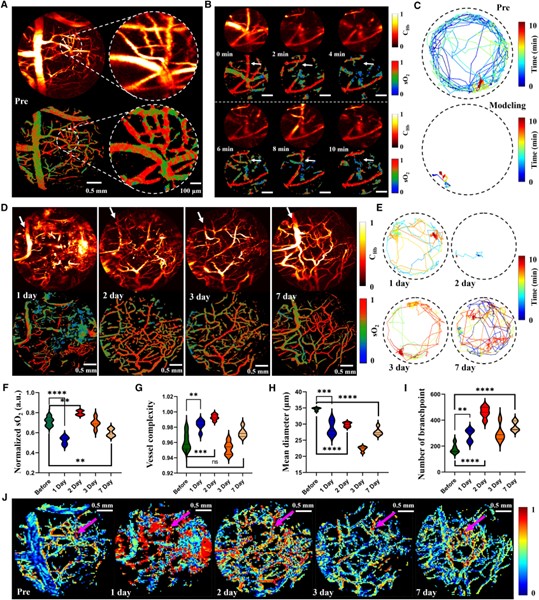
The study reveals that single-vessel occlusion does not occur linearly but follows a dynamic ‘occlusion–recanalisation–reocclusion’ pattern, indicating that vessels possess a certain capacity for thrombus clearance. As haemoglobin content and oxygen saturation decline, mice exhibit progressively reduced locomotor activity. The team observed that, in severe occlusion models, vascular structural remodelling and functional connectivity changes, along with transient improvements in oxygen saturation, although mortality remained high. A mild occlusion model was also established for 28-day longitudinal monitoring, documenting vascular recanalisation, motor recovery, and functional network reorganisation.
This technology provides a novel platform for stroke modelling and brain disease research, enabling real-time, high-resolution imaging of vascular occlusion in freely moving animals and overcoming the limitations of traditional imaging techniques. The PHM system employs dual-wavelength excitation and photoacoustic detection, weighs less than 2.3 g, and offers a field of view exceeding 8 mm² with a temporal resolution of 330 ms. Beyond stroke research, the PHM system can be extended to studies of neurodegenerative disorders such as Alzheimer’s and Parkinson’s disease.
Yuan Zhen is the corresponding author of the study, with Liang Xiao, a doctoral graduate of UM FHS, as the first author. Xi Lei, professor at the Southern University of Science and Technology, also contributed to the study. The research was supported by the Shenzhen Medical Research Fund (File No: B2402046); UM (File Nos: MYRG2022-00054-FHS, MYRG-GRG2023-00038-FHS-UMDF, MYRG-GRG2024-00259-FHS); the Macao Science and Technology Development Fund (File No: FDCT 0014/2024/RIB1); the National Natural Science Foundation of China (File No: 62435008); the Shenzhen Science and Technology Program (File Nos: RCJC20231211090039066, JCYJ20230807093105010), and a start-up grant from the Southern University of Science and Technology (File No: PDJH2021C008). The full version of the research article is available at: https://www.cell.com/cell-reports-physical-science/fulltext/S2666-3864(25)00555-7.
| Source: Institute of Collaborative Innovation | |
| Media Contact Information: | |
| Communications Office, University of Macau | |
| Albee Lei | Tel: (853) 8822 8004 |
| Bell Leong | Tel: (853) 8822 8009 |
| Email: | prs.media@um.edu.mo |