Rising
Enrolment for Japanese Studies
By Cynthia
Chan
 The
number of students applying for the Japanese Studies program in
the University of Macau (UM) has increased since the program started
in 2003. The
number of students applying for the Japanese Studies program in
the University of Macau (UM) has increased since the program started
in 2003.
The
Japanese language is the second most popular language course taken
by students in UM. In reviewing the demand, the Faculty of Social
Sciences and Humanities (FSH) launched the Japanese Studies Program
in 2003.
Before
2003, FSH had cooperated with the Faculty of Business Administration
(FBA) to hold a program called the Japanese Studies and Business
Management since 1992. In 2003, FBA decided to re-organize the program
with a wider focus on International Business. After FBA's curriculum
change, FSH proposed to launch a new program dedicated to the field
of Japanese language study.
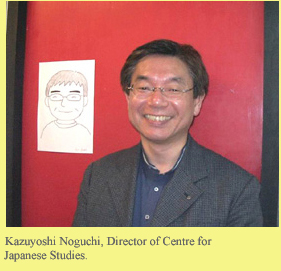
Kazuyoshi
Noguchi, director of the Centre for Japanese Studies who has been working
in UM since 1992, said that the program started with 27 students
at the beginning. In the academic year 2004, 39 students enrolled
in this program, a more than 40 percent increase in the enrolment.
Noguchi
said that when designing the program, they were aware that if students
know only the Japanese language after graduation, they would be
less competitive than graduates of some universities in mainland
China such as the Shanghai Foreign Language University, which has
a very good Japanese studies program. For this reason, they offer
the program with a very flexible credit arrangement. Noguchi said
that out of the 144 credits that a student needs for graduation,
90 credits are on Japanese studies courses while 36 credits are
free elective courses. Students are expected to take at least 24
credits on another subject they are interested in from FSH or FBA
such as English studies, management, communication, etc.
"This
way, students will know not only the Japanese language after graduation,
but also have some concentration in another field and they will
be more competitive in terms of knowledge," said Noguchi. "Similar
programs in some universities in mainland China mainly concentrate
on the language and students know only one language after graduation,"
he said, adding that this is the "selling point" of the
Japanese Studies program in UM.
Although
more students are getting into this program, "to survive"
in this program is not easy. Noguchi said that three students dropped
out of the program due to the grade last year.
"You
can't study a language just before examinations," said Noguchi.
"We want students to study constantly every day and prepare
for classes."
Despite
the challenges, the most attractive part of this program is the
chance to go to Japan. There are short-term and long-term exchange
programs. For the short-term program, 45 students can go to Japan
this year in the summer for 10 days to two weeks for home stay in
Kagoshima and Nagoya or studying Japanese courses in the Kagoshima
Asia-Pacific Cultural Village.
The
long-term program allows students to study in Japan for one year.
The universities involved are: Akita International University, Keio
University, Soka University, Shigakukan University and Okinawa International
University. Some 12 students will join the one-year exchange program
this year.
Aside
from the exchange programs, student activities such as parties,
camping, etc. also help to forge a very good relationship between
students and teachers. There are currently five teachers and three
interns working in the Japanese Studies program.
"We
want our students to enjoy their campus life and that is the most
important thing besides studying," said Noguchi with a smile.
Top
|