
Copyright! Copy Right?!
By Sharis Lee
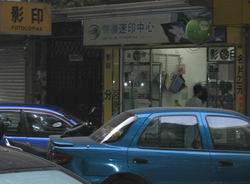
The Macau Customs raided two photocopying shops in Hak Sha Wan and uncovered 4,000 unauthorized photocopies of textbooks on September 1 following complaints from some publishers.
A photocopying shop in Macau
One shop owner and nine employees were detained, as they were suspected of violating the "Códitgo do Direito de Autor" (the Law of Copyright).
Tong Chi Kin, a member of the Legislature said that similar events happened before, but the public has not paid adequate attention. Tong attributed the reason for such cases to the continuous rise in textbook prices. Parents and students would simply chose to photocopy textbooks instead of buying them in order to save money. Besides, Tong said that parents and students know little about the copyright law, which itself is also vague about what exactly the "copyright" is. He thus urged the Macau government to take more steps on law improvement and on educating the public about the copyright protection in the future.
Although there has been a used-book market within the academic circle, some students would still photocopy textbooks, especially workbooks instead of buying used ones. "When I ask students for the reasons, they just claimed that their teachers do not oppose the idea of using the photocopies of textbooks at all...They know that there would be no used workbooks for sale, so do the new editions which nobody has used before," said Pang Lai, who is in charge of the Course Books Service Center, a bookstore selling both new books and used books.
Parents and students also complained that they could not get textbooks in the second-hand market as they are so often changed into a new edition nobody has used before. "How could I buy the used textbooks which come out completely into a new edition?" Joey Leong, a Form 3 student of Colegio Diocesano De Sao Jose said. "Publishers make their money on new books. They are so cruel that they just consider their own benefits. They would change books into a new edition no matter how few changes there would be. Worse enough, some changes would be as minor as simply altering the positions of the texts and pictures."
Gloria Wong, mother of a Form 3 student in Yuet Wah College (Chinese Section), said, "We would buy new textbooks only if there are no used ones; maybe they are in new editions for improvement. We know that it's quite hard for my child to keep up in class using different editions of textbooks. Even though the different editions may look alike, there are some differences in the format, pictures and so on. However, we would try our best to find used books first until the last moment!"
A recent study by the California Student Public Interest Research Group found that the average release time between textbook editions is 3.8 years, regardless of whether the information has changed from the previous version. Of the textbooks surveyed, new editions cost 58 percent more than the older versions, making an average textbook cost US$102.44, which is almost MOP822 per textbook.
However, Kuong Mon I, director of the Macau Publications Association, argued that textbooks must be continually updated if publishers want to keep the attention of today's college students, who are used to the graphics and interactivity of the Internet. Besides, due to the factor that "the freshness strengthens the market", the newer the edition, the greater the demand because of the way books were being redesigned. But to add those fancier pictures and more thorough flow charts involves expensive design jobs which charge high royalties. Therefore it would add up to higher textbook prices, Kuong said.
Edward Zheng, an invited associate professor and the director of Research Center for Chinese Culture (RCCC), University of Macau mentioned that the choice of textbooks was a kind of reflection of the "intellectual and cultural standing" of a citizen. It is no doubt that there would be some unethical merchants making profits by copyright infringement. Therefore the authorities should keep a watchful eye on the case.
Erica Lao, a Year 3 student majoring in Marketing of the Faculty of Business Administration, said that it is not difficult to understand the consumer's logic in photocopying behaviour. "The photocopies are characterized as having not only the quality of cleanliness and tidiness of a new book, but also the lower cost, which is also an attractive 'advantage' like the used books. Research showed that the cost of a photocopy is just one third of the price of the original book or even lower than that. The difference between them is quite a lot."
However, when asked what they would like to have-the original textbook or the photocopy one, some students said that they would prefer the former since the original one is colourful and more attractive, especially for books which have graphics and charts in different colours. "Sometimes, we are forced to photocopy some of the textbooks since we have no alternative in the matter that the books are out of stock. And it would take quite a long time for the books to arrive," said Chris Choi, a Form 1 student of Escola S.João de Brito. He is busy looking for his textbooks as he just learned that he has passed the re-sit examination and would continue his study.
Some teachers would photocopy appropriate exercises and passages and hand them to students as teaching materials. "On the premise that it's impossible and unreasonable for each student to buy the original copies of the reference books since we should consider that not the whole textbook would be used. In my opinion, I would think that photocopying is more environmentally friendly since it uses less paper than the whole textbooks," said Moon Wei, a teacher of a central district school. "Actually, we would photocopy only the pages which are useful as teaching materials but not whole books. In my opinion, I'm not quite sure of the 'photocopying standard' in regards to the concept of 'copyright'. It is because our school and even our government both have not stipulated the quantity limit of photocopies." She said that she would pay more attention to the development of the photocopy incident and would like to use the Hong Kong photocopying standard for reference. As an educational worker, she said she would like to set a good example with her own conduct in order to educate the next generation to respect others and to value "intellectual property".
On the other hand, workers of photocopying shops emphasized that they would not simply make photocopies of the whole books for customers from now on. And some of them even claimed that they would not accept textbooks for photocopying since they are afraid of violating the law. "Some parents wonder why we do not make photocopies of the books for them and they seem very annoyed. Some of them even claimed that the photocopies are just used for their children as exercises at home," said Ling Kuoc, one of the staff of a photocopying shop.
Jerry Leong, a Year 3 student majoring in Law in Chinese Language of the Faculty of Law said, "It was the first time the Customs made use of the 'Código do Direito de Autor' to investigate the photocopying business. The investigation involves the continuing concerns of the copyright problem within the publishing circles and the rapid development of the photocopying business. Beside, Macau citizens do not have adequate knowledge of copyright. It is important that the government should do more promotions related to the field in order to enhance people's consciousness. There are also some gray areas where the law of copyright is not clearly defined in Macau. In comparison, Hong Kong's copyright law stipulates that if people make photocopies of more that 10 percent of the book, they are considered violating the law of copyright." He suggested that the government should make some amendments in the law in order to eliminate the gray area in the system.
In general, copyright laws grant authors and creators of published and unpublished literary, scientific and artistic works the exclusive right to reproduce, distribute, perform and display their work publicly. The content or any part of them shall not be reproduced, modified, adopted, distributed, transmitted, downloaded or saved without prior consent of the authors/producers. However, it is usually permitted that users may reproduce some of the content provided that it is used solely for private and non-commercial use. The violation of the law of copyright is considered as a kind of criminal offense. The penalty for the offenders would be imprisonment from one year to four years in Macau. Some would face fines and the confiscation of shop equipment.
Macau has about 130 schools (not including tertiary institutions) with a total number of 99,183 students, which form a stable market for textbooks. A better defined copyright law would benefit both students and publishers.