Legislature election satisfactory
By Agnes Vong
|
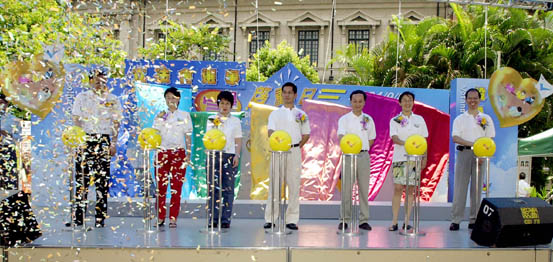
| The election committee members celebrate the start of the promotional period for the Legislative Assembly Election. (Countesy GCS) |
The turnout rate of the direct election for members of the legislative assembly this year is found to be satisfactory. With 52.32 per cent registered voters (83,619 out of 159,813) casting their votes, it shows people's active participation in politics.
Compared to the1996 election (75,093 votes out of 116,445), the turnout rate this year dropped by 12.17 per cent. This drop is found to be reasonable, though. The 1996 election result was believed to be abnormal as election scandals were rampant. There were reported cases that people voted not out of their willingness to participate, but because they were paid to do so.
To combat the corruption problem, Macao's Commission Against Corruption (CCAC) has been very efficient in educating people that buying votes is wrong and will be penalized if caught. This may result in a lower turnout rate as some people, particularly less-educated people, who realized that they could not get any 'direct benefits' from their votes, might prefer
to stay home instead.
This year's election has also shown people's awareness to politics and their knowledge of which candidates could represent their voices. Ng Kwok Cheong, who is seen to be the most-outspoken candidate by the general public and at the same time viewed as a trouble-maker in the eyes of government officials, has received 16,960 votes, the highest among all the candidates. This reflects that Macao citizens have begun to understand the importance to participate in the election and are eager to vote
for those who can best represent their voices in the legislature.
The turnout rate of 52.32 per cent, though may not be considered a high ratio in some mature democratic countries, means a lot to Macao. As the Portuguese had ruled the region for such a long period of time, people gradually lost their interest in politics under the colonial government. The handover at the end of 1999 put back the power of governance into the hands of
the Chinese and people's attitude towards politics began to change.
For the time being, only 10 out of the 27 of the Legislative Assembly seats are directly elected, which means that Macao voters have
limited power to influence the government through elections. Nevertheless this system will change in the near future as the democratic politics starts taking
root in the city. According to the basic laws, the method for forming the legislature in Macao will be modified in 2009. With the approval of the Chief Executive, there will be an opportunity that more than half of the seats in the
legislature could be directly elected.
